Sunday, September 04, 2022

when art feels meaningless

Florent Farges is a French artist who often discusses philosophical issues related to art. This is one of his best (and one of the best explanations I've ever seen).

https://www.youtube.com/watch?v=ffoR6DuwTTo


Excerpt:


Transcript:


Photo of Milky Way

Amazing.


Have you ever seen a 9-gigapixel map of the Milky Way galaxy? This jaw-dropping zoomable image by ESO contains ~84 million stars and it's unlike anything you’ve ever seen. The original image has 24.6 gigabytes [image: buff.ly/R1dS5X] [read more: buff.ly/3D9FR1Y]

Download here: https://www.eso.org/public/usa/images/eso1242a/?lang

Zoomable here: https://www.eso.org/public/images/eso1242a/zoomable/


Monday, August 29, 2022

The contrarian way

Another great piece from Andy Kessler:

https://www.wsj.com/articles/live-the-contrarian-way-zuckerberg-musk-complacency-skepticism-investing-expectations-debate-thinking-thought-11661651369?mod=hp_opin_pos_6#cxrecs_s

(free link)

https://www.wsj.com/articles/live-the-contrarian-way-zuckerberg-musk-complacency-skepticism-investing-expectations-debate-thinking-thought-11661651369?st=rwuagfsxzo6kr4t&reflink=desktopwebshare_permalink

Live the Contrarian Way

Like Mark Zuckerberg and Elon Musk, I try to lean against prevailing thought.

PHOTO: GETTY IMAGES/ISTOCKPHOTO

I have to admit it: I’m a contrarian. It’s who I am. Dorothy Parker once said, “The first thing I do in the morning is brush my teeth and sharpen my tongue.” Me too—one needs to be sharp for contrarianism.

I started early. In college, I was a charter member of the Poachers Society. We would threaten to bite alligators off the Lacoste shirts that seemingly everyone else was wearing. I may have no fashion sense, but I got good at figuring when something was overdone, “so in that it’s out.” Or even better, seeing the future coming and sensing what was “so out that it’s in.” I declared that disco was dead the first time I heard it. I was right . . . though a bit early, an important lesson.

Many think contrarians are skeptics. Or curmudgeons. Or just crusty. I often get tweet-bombed after many of this column’s rants, sometimes with an image from “The Simpsons” showing a newspaper headline: “Old Man Yells at Cloud.” Au contraire, we are more like nonconformists, leaning against prevailing moods. And no question, Twitter really is a cesspool of snark, though it’s useful as a Parkerian tongue-sharpener.

Being contrarian isn’t about playing devil’s advocate. The devil is too doctrinaire. It isn’t about being cynical either, though a dose of both surely helps. It’s more about seeing things a bit different, like Apple’s old “Think Different” ads.

NEWSLETTER SIGN-UP

Morning Editorial Report

All the day's Opinion headlines.

At an airport recently, I saw a woman wearing a T-shirt that read, “ ‘Nah.’ Rosa Parks 1955.” I want one.

Don’t think contrarians are stuck in the mud. We know that change is constant and that progress happens via surprises that should come as no surprise. This is where most good things happen. Richard Feynman, who won the Nobel Prize in Physics, once said, “There is no harm in doubt and skepticism, for it is through these that new discoveries are made.”

It takes work. On a podcast, Facebook founder Mark Zuckerberg said, “After going through a bunch of these cycles, I actually feel like I’ve trained myself to see it the opposite way, which is if I’m doing something that feels too well understood for too long, then I feel like I’m just being complacent.” Complacency is the bitter enemy of all contrarians.

Except for overpaying for Twitter, Elon Musk is a classic contrarian, embracing electric vehicles, privately launched rockets, underground tunnels and even flamethrowers that others never considered.

Great investors are contrarian. They take the pulse or check the weather vane of what’s going on today and insist it’s wrong. Why? Because expectations today are always wrong tomorrow. Every day the stock market is on the move because the world changes by the minute. The status quo is never right for long. Of course, the trick to investing is deciding in which direction the world is wrong and determining when others will figure it out.

When the world does catch up to your way of thinking, you’ve got to train your mind to move on, to be contrarian all over again, even though your previous view ended up being right as rain. There is no time to celebrate, which invites complacency. Contrarians, like sailors, are usually grumpy and constantly lean into the prevailing wind.

Fidelity Investments CEO Abigail Johnson noted of her father, Ned Johnson, after he died recently: “He loved his family, his co-workers, work, the stock market, art and antiquities, tennis, skiing, sailing, history, and a good debate. He could be counted on to have the contrarian view on just about anything.” Of course he did.

Sure, sometimes being a contrarian can be disorienting, like two lost mountain climbers with a map trying to figure out where they are until one confidently points into the distance and says, “See that mountain over there? We’re on top of that one.” It always helps to be grounded.

Philosopher Arthur Schopenhauer got it right, saying, “All truth passes through three stages. First, it is ridiculed. Second, it is violently opposed. Third, it is accepted as being self-evident.” We contrarians set up camp around stage two. When others join in, you learn to ride the tiger for just long enough to jump off as ideas become mainstream.

Contrarians constantly question everything. Annoying, I know. But it isn’t just naysaying. As Monty Python famously pointed out, an argument “isn’t just saying, ‘No it isn’t.’ ‘Yes it is.’ ‘No, it isn’t.’ ” Unless you can figure out why everyone else is wrong, you’re just being a grouch. To be good at it, contrarians think ahead and, like Elon Musk, envision a world that others can’t yet see. Dream on my fellow contrarians, we have a world to build.

Sunday, August 28, 2022

Bill Barr on modern society

This Bill Barr interview is amazing. An excerpt:

https://www.commonsense.news/p/bill-barr-calls-bullsht?triedSigningIn=true

BW: You gave a speech in 2019 at Notre Dame that I read at the time and have since reread. It’s a very powerful talk about religious liberty and freedom. In the speech, you argue that not only is religious liberty an imperative to free government, but that religion itself is what protects us from the dangers of freedom. You say that religion promotes moral discipline and a virtue that’s  needed to support a free government and free institutions. You quote our founders like John Adams: “We have no government,” he said, “armed with the power which is capable of contending with human passions unbridled by morality and religion. Our Constitution was made only for a moral and religious people. It is wholly inadequate for the government of any other.” What do we do when we have such a constitution, but a growing number of Americans aren’t religious? 

AG BARR: The framers would have said that if that persists for a long time and people aren’t able to control themselves and govern themselves and sink into licentiousness and so forth that we’re not going to have a free society. The government will adopt rules, and all our decisions will be made for us by the government. The whole idea of limited government was predicated on religion, that religion would allow people to govern themselves. As long as people could govern themselves then you could have limited government. At the end of the day, you will have government, and if it’s not self-government, it’ll be the coercive power of the state.

I think one of the problems we have today is that we’re a more pluralistic, more religiously fractured society. People’s values vary widely. In 1960, 95% of the country self-identified as believing Christians, and that’s no longer the case. I think we have to understand that in a pluralistic society, we have to live and let live. This means we have to, for example, stop trying to run schools like monolithic state institutions that are neutral as to values and morality but allow people to choose through vouchers where they want their children educated. If they want their kids brought up in a religious tradition, allow them to have their school. This is what they do in England. This is what they do in Europe. Here we are, where we supposedly fled from Europe to have religious freedom, but if you want to raise your kid within a religious tradition, you have to pay through the nose for private school. Otherwise, you’re sending your kid to a public school. And the problem today is that a lot of what's being taught in public schools is antithetical to traditional religious belief.

The left talks about diversity, but I’m for real diversity. I think that will enrich education. I think it will not hurt the melting pot that we have. You look at parochial schools today and religious schools, they raise patriotic citizens who function in a pluralistic society very well. So, I think the answer is let people make the choice and let's see what happens. 

BW: Do you think that Americans are increasingly trying to get out of politics what they may have gotten once out of religion and religious identity? 

AG BARR: I think there’s no question about it. I think that secular progressivism—what I refer to as the radical progressive view—it’s like a religion and it has that intensity. This is what has made our politics so venomous. The opponents of the progressive forces aren’t just wrong, they’re evil because they’re standing in the way of the salvation of the human race. This contributes to the dehumanization of one's political adversaries and so forth. Talking about religious wars, these are like religious wars, the hatred that’s involved in it. 

Sunday, August 21, 2022

Composition of the universe

The graphic at the end of this post shows the composition of the universe.

https://www.visualcapitalist.com/composition-of-the-universe/

Meanwhile, the Webb telescope raises questions about the Big Bang theory.

https://hotair.com/jazz-shaw/2022/08/17/astronomers-looking-at-webb-what-if-the-big-bang-didnt-happen-n490341

Like me, I’m guessing that many of you have been enjoying the new, deep-space images being delivered by the James Webb Space Telescope (JWST) since it came fully online. We’ve been seeing remarkable star fields and beautiful dust cloud formations. We’ve also been seeing galaxies far from the Milky Way that have never been seen before. And I mean lots of new galaxies. To the average layman, that’s really just more pictures to “ooh” and “ahhh” at. But for astronomers and cosmologists reviewing all of this new data, it isn’t turning out to be a wonderful experience at all. Many of them have already begun reporting that there’s something not quite right with the seemingly endless parade of ancient and frequently small galaxies out there. Few are saying it out loud yet, but they are speculating that one theory that has been taken as fact for a very long time now may not have been correct. The dreaded conclusion could turn out to be that the big bang theory is wrong and it may never have happened. (ia.tv)

To everyone who sees them, the new James Webb Space Telescope (JWST) images of the cosmos are beautifully awe-inspiring. But to most professional astronomers and cosmologists, they are also extremely surprising—not at all what was predicted by theory. In the flood of technical astronomical papers published online since July 12, the authors report again and again that the images show surprisingly many galaxies, galaxies that are surprisingly smooth, surprisingly small and surprisingly old. Lots of surprises, and not necessarily pleasant ones. One paper’s title begins with the candid exclamation: “Panic!”

Why do the JWST’s images inspire panic among cosmologists? And what theory’s predictions are they contradicting? The papers don’t actually say. The truth that these papers don’t report is that the hypothesis that the JWST’s images are blatantly and repeatedly contradicting is the Big Bang Hypothesis that the universe began 14 billion years ago in an incredibly hot, dense state and has been expanding ever since. Since that hypothesis has been defended for decades as unquestionable truth by the vast majority of cosmological theorists, the new data is causing these theorists to panic.

Alison Kirkpatrick, an astronomer at the University of Kansas in Lawrence, is quoted as saying, “Right now I find myself lying awake at three in the morning and wondering if everything I’ve done is wrong.”

I’m not going to pretend that I have the scientific mental horsepower to understand the mechanics behind all of this, but science journals are quoting people who certainly should be able to understand it. If the universe has been expanding since its inception 14 billion years ago, the galaxies the furthest away from us should appear huge and have a certain amount of “red shift” in their light. But what Webb is showing us is almost exactly the opposite.
That’s a problem for the big bang theory. If the universe was born in a monumental blast with everything traveling outward at incredible speed, all of that matter should still be traveling and expanding. But it doesn’t appear to be. In fact, the universe might not really be expanding at all. And if it’s not expanding, then it probably didn’t come from a massive explosion at a single point in the void. If that’s the case… where did all of this stuff come from?

There are more issues to deal with. The most distant galaxies Webb has located are being seen when they were as little as 400 million years old, as determined by when the big bang is assumed to have happened. That means their stars should all still be hot and blue in color as all young stars are. But many of them are cooler and reddish in color, signifying that they should be at least a billion years old.

According to Big Bang theory, the most distant galaxies in the JWST images are seen as they were only 400-500 million years after the origin of the universe. Yet already some of the galaxies have shown stellar populations that are over a billion years old. Since nothing could have originated before the Big Bang, the existence of these galaxies demonstrates that the Big Bang did not occur.
Scientists are obviously more worried about having gotten the science wrong and having to figure out a new theory if that’s the case. But assuming this is true, it also could have ramifications for both religious and spiritual contemplation of the origins of everything. Creationists assure us that God (whomever you take that to be) created everything we see in a very short amount of time. With a bit of squinting, you can match that up as a non-scientific analogy to the big bang theory. But what’s the scientific explanation for trillions of galaxies that appear to all just be “hanging around?”

Perhaps the faithful have a better escape hatch from this dilemma than the scientists. If God was able to create everything all at once in one tiny spot and send it careening across the void, why couldn’t He create trillions of things wherever He wanted them to be and whenever He felt like it over a longer span of time than we’ve been able to imagine thus far? Food for thought, to be sure.


Saturday, July 16, 2022

Debt Jubilee

This makes sense:

http://charleshughsmith.blogspot.com/2022/07/the-only-real-solution-is-default.html


FRIDAY, JULY 15, 2022

The Only Real Solution Is Default

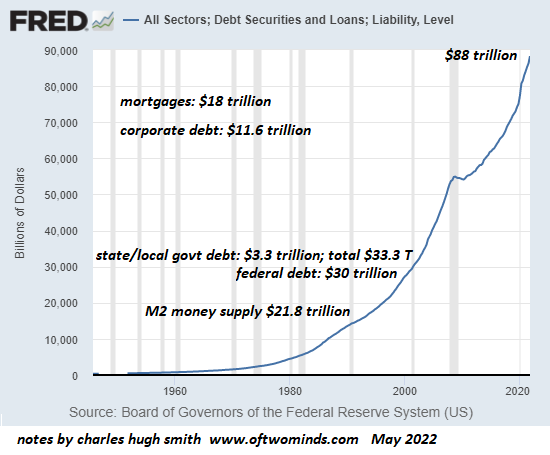
The destruction of 'phantom wealth' via default has always been the only way to clear the financial system of unpayable debt burdens and extremes of rentier / wealth dominance.

The notion that the world could always borrow more money as long as interest rates were near-zero was never sustainable. It was always an unsustainable artifice that we could keep borrowing ever larger sums from the future as long as the interest payments kept dropping.

The only real solution to over-indebtedness since the beginning of finance is default. There are pretty names for variations on default that sound much less gut-wrenching--debt jubilees, refinancing, etc.-- but the bottom line is the debts that can't be paid won't be paid and whomever owns the debt as an asset absorbs the loss.

Every default is a debt jubilee for the borrower. Whether the default is informal or formalized in bankruptcy, the debt payments are no longer being paid to the lender / owner of the debt.

Every debt jubilee is a default that forces the owner of the debt to write the value down to zero and absorb the loss. The jubilation of the owner of the debt is rather muted unless the state swoops in and passes the losses onto the taxpayers via bailouts / transferring the losses to the public's balance sheet.

Every default is a refinancing--to zero. We've refinanced the debt so the borrower pays zero and the value of the loan / debt is now zero.

Very few ordinary households own other people's debts as assets. It's the wealthy few who own most of the student loans, vehicle loans, mortgages, government and corporation bonds, etc.

Yes, ordinary households may own other people's debts through pension plans or ownership of mutual funds, but by and large debt is a favored asset of the rentier class, i.e. the wealthiest few.

We're constantly told that mass defaults would destroy the economy, but this is flim-flam: mass defaults would destroy much of the wealth of the rentier class which has been greatly enriched by the global expansion of debt, while freeing the debtors of their obligations.

Recall that debt is the transfer of income from the borrower to the owner of the debt. Borrowing money is like every other form of consumption: when it's cheap and abundant, we over-indulge. The costs are only apparent after the banquet has been cleared.

The illusion that the global economy could effortlessly add trillions in debt to fund living large forever was based on a brief historical anomaly of zero interest rates enabled by low inflation. There's a long lag between the vast expansion of debt / consumption and the eventual consequences on supply, demand, risk and price discovery.

The lag time is up and now the consequences are finally visible: the tide of rapid growth in consumption and income required to fund ever-greater burdens of debt has ebbed, and so the global burden of debt--$300 trillion or so-- is no longer sustainable / payable.

The favored solutions of the state--printing money or transferring the losses to the public--are no longer viable. Now that inflation has emerged from its slumber, printing trillions to bail out the wealthy is no longer an option. The public, so easily conned into accepting the bailout of the wealthy in 2008, has wised up and so that particular con won't work again. ("Bail out the super-wealthy now or your ATM machine will stop working!" Uh, right.)

The state is the protector of the wealthy, and so defaults that actually impact the wealthy are anathema. The wealthy will demand the state absorb their losses (recall that profits are private, losses are socialized) The only equitable solution is to force the losses on those who bought the debt as a rentier income stream.

I've been exploring the Core-Periphery dynamic for a decade. ( The E.U., Neofeudalism and the Neocolonial-Financialization Model May 24, 2012). This dynamic plays out in a number of ways on a number of levels.

Defaults will play out along the lines of Core-Periphery asymmetries. Some states will be able to "print their way out of default" but most will not, as unrestrained printing of money on such a vast scale would devalue the currency, triggering an even more destructive systemic default.

Debt is a double-edged form of power. Being able to borrow and spend huge sums is an absolutely fabulous way to expand corruption, bribes, exploitation of the powerless, bridges to nowhere and mindless over-consumption, but the habits formed by mindless expansion of debt to fund soaring wealth inequality don't serve the indebted entities very well when default removes borrowing as a way to pay and play.

Living within one's means--i.e. net income--is the only solution there has ever been to the end-game of over-indebtedness, i.e. default. Those with relatively secure, diversified net incomes (i.e. the Core) will do much better than those with unstable, limited income.

The destruction of phantom wealth via default has always been the only way to clear the financial system of unpayable debt burdens and extremes of rentier / wealth dominance. Let's guess that a bare minimum of $100 trillion of the $300 trillion mountain of global debt will default far sooner than most expect. The only question is who will absorb the $100 trillion in losses. Choose wisely, as defaults of debt that are transferred to the public end up bringing down the entire system via political overthrow or currency collapse.


Recent podcasts/videos:

Tectonic Shift of Mercantilism Revalued (Gordon Long, Macro-Analytics, 42 min)

My new book is now available at a 10% discount this month: When You Can't Go On: Burnout, Reckoning and Renewal.

If you found value in this content, please join me in seeking solutions by becoming a $1/month patron of my work via patreon.com.


My recent books:

Global Crisis, National Renewal: A (Revolutionary) Grand Strategy for the United States (Kindle $9.95, print $24, audiobook) Read Chapter One for free (PDF).

A Hacker's Teleology: Sharing the Wealth of Our Shrinking Planet (Kindle $8.95, print $20, audiobook $17.46) Read the first section for free (PDF).

Will You Be Richer or Poorer?: Profit, Power, and AI in a Traumatized World
(Kindle $5, print $10, audiobook) Read the first section for free (PDF).

Pathfinding our Destiny: Preventing the Final Fall of Our Democratic Republic ($5 Kindle, $10 print, ( audiobook): Read the first section for free (PDF).

The Adventures of the Consulting Philosopher: The Disappearance of Drake $1.29 Kindle, $8.95 print); read the first chapters for free (PDF)

Tuesday, July 12, 2022

The new Antoinettes

Thoughtful article from Victor Davis Hansen. The conflicts in the USA are more rich vs poor than left vs right, but the left distracts the poor by pointing at the right.

https://www.zerohedge.com/political/victor-davis-hanson-left-wing-elites-are-our-new-antoinettes


The modern left-wing elite are becoming our version of Antoinettes. Thirty-eight-year-old Mark Zuckerberg is worth over $60 billion. But he enjoys T-shirts, jeans, and apparent simplicity in his many landed estates. He is so worried about the wrong voting tendencies of the clueless middle classes that he poured nearly $420 million of dark money from his vast fortune into the 2020 election—de facto absorbing the work of key precinct registrars—to ensure the “right” result for the unthinking multitudes. 

Americans, almost uniquely among modern nations, mostly do not envy, much less despise the rich. But there is a certain sort of privilege that they do not like: the sanctimonious and hypercritical rich whose rhetoric is at odds with their own lifestyles and the methods by which they inherited or made vast sums. And they especially are turned off by those who exude open disdain for the clinger/deplorable/dregs class—to paraphrase the Barack Obama, Hillary Clinton, and Joe Biden nomenclature. 

An especially grating habit of the left-wing wealthy is to lecture the middle class on their supposed illiberality. Often, those struggling are told they need to pay more for what White House economic advisor Brian Deese recently called the “liberal world order.” 

Bill Gates, Warren Buffett, or George Soros, to take a few examples, are multibillionaires who live lives unlike any in the history of civilization. They also fund various agendas through multibillion-dollar foundations and their own personal riches. 

Their causes are all deemed critical to the nation and planet, but unfortunately not fully appreciated as so vital by the peasant classes—whether they be global governance, massive restructuring of the economy to stop carbon releases, radical abortion on demand, or the sponsoring of critical legal theory prosecutors who feel crime is but a rich man’s construct. 

Indeed, when various pollsters recently asked the public what their chief worries were, they found the culprits were the prohibitive price of gasoline, the ruinous effects of hyperinflation, supply chain shortages, the nonexistent southern border, or the escalating violent crime wave—all of which concerns are of apparent little interest to left-wing billionaires. 

In other words, the worries of the Antoinette liberal elite—climate change, abortion on demand, transgenderism, strict gun-control—are not those that terrify the middle and lower classes. The latter, for some reason, first want to survive one more day with enough affordable food and energy and to be safe from criminals. 

Why Democrats are currently unpopular transcends even Joe Biden’s daily, dangerous, and tragic loss of cognition. Their low ratings arise more from the implementation of an array of disastrous policies dreamed up at left-wing university departments and think tanks. 

As a result, voters have concluded that the Left “just doesn’t care.” 

By that, they conclude that the drivers of modern hard progressivism—the billionaire donor class, the highly compensated professional bicoastal elites, the ideologues who have captured and transformed the old Democratic Party—ignore criticism of their policies. Or they claim that their disasters are unappreciated benefits, or mere PR problems, or shift blame to the Russians, the Emmanuel-Goldstein Trump, the toadish media, or the victims of their disastrous policies.