If you don't have your own copy of the Navalmanack, what are you waiting for? You can download a .pdf for free or read it on the web.
Wednesday, December 23, 2020

Monday, November 30, 2020
Quantum experiment: no objective past
A simulation creates narrative on demand, including the past.
Now an experiment seems to demonstrate that.
_____
A quantum experiment suggests there’s no such thing as objective reality
Physicists have long suspected that quantum mechanics allows two observers to experience different, conflicting realities. Now they’ve performed the first experiment that proves it.
Excerpt:
Back in 1961, the Nobel Prize–winning physicist Eugene Wigner outlined a thought experiment that demonstrated one of the lesser-known paradoxes of quantum mechanics. The experiment shows how the strange nature of the universe allows two observers—say, Wigner and Wigner’s friend—to experience different realities.
Since then, physicists have used the “Wigner’s Friend” thought experiment to explore the nature of measurement and to argue over whether objective facts can exist. That’s important because scientists carry out experiments to establish objective facts. But if they experience different realities, the argument goes, how can they agree on what these facts might be?
That’s provided some entertaining fodder for after-dinner conversation, but Wigner’s thought experiment has never been more than that—just a thought experiment.
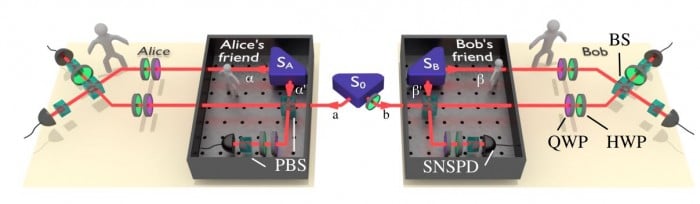
Last year, however, physicists noticed that recent advances in quantum technologies have made it possible to reproduce the Wigner’s Friend test in a real experiment. In other words, it ought to be possible to create different realities and compare them in the lab to find out whether they can be reconciled.
And today, Massimiliano Proietti at Heriot-Watt University in Edinburgh and a few colleagues say they have performed this experiment for the first time: they have created different realities and compared them. Their conclusion is that Wigner was correct—these realities can be made irreconcilable so that it is impossible to agree on objective facts about an experiment.
Wigner’s original thought experiment is straightforward in principle. It begins with a single polarized photon that, when measured, can have either a horizontal polarization or a vertical polarization. But before the measurement, according to the laws of quantum mechanics, the photon exists in both polarization states at the same time—a so-called superposition.
Wigner imagined a friend in a different lab measuring the state of this photon and storing the result, while Wigner observed from afar. Wigner has no information about his friend’s measurement and so is forced to assume that the photon and the measurement of it are in a superposition of all possible outcomes of the experiment.
Wigner can even perform an experiment to determine whether this superposition exists or not. This is a kind of interference experiment showing that the photon and the measurement are indeed in a superposition.
From Wigner’s point of view, this is a “fact”—the superposition exists. And this fact suggests that a measurement cannot have taken place.
But this is in stark contrast to the point of view of the friend, who has indeed measured the photon’s polarization and recorded it. The friend can even call Wigner and say the measurement has been done (provided the outcome is not revealed).
So the two realities are at odds with each other. “This calls into question the objective status of the facts established by the two observers,” say Proietti and co.
That’s the theory, but last year Caslav Brukner, at the University of Vienna in Austria, came up with a way to re-create the Wigner’s Friend experiment in the lab by means of techniques involving the entanglement of many particles at the same time.
The breakthrough that Proietti and co have made is to carry this out. “In a state-of-the-art 6-photon experiment, we realize this extended Wigner’s friend scenario,” they say.
They use these six entangled photons to create two alternate realities—one representing Wigner and one representing Wigner’s friend. Wigner’s friend measures the polarization of a photon and stores the result. Wigner then performs an interference measurement to determine if the measurement and the photon are in a superposition.
The experiment produces an unambiguous result. It turns out that both realities can coexist even though they produce irreconcilable outcomes, just as Wigner predicted.
That raises some fascinating questions that are forcing physicists to reconsider the nature of reality.
The idea that observers can ultimately reconcile their measurements of some kind of fundamental reality is based on several assumptions. The first is that universal facts actually exist and that observers can agree on them.
But there are other assumptions too. One is that observers have the freedom to make whatever observations they want. And another is that the choices one observer makes do not influence the choices other observers make—an assumption that physicists call locality.
If there is an objective reality that everyone can agree on, then these assumptions all hold.
But Proietti and co’s result suggests that objective reality does not exist. In other words, the experiment suggests that one or more of the assumptions—the idea that there is a reality we can agree on, the idea that we have freedom of choice, or the idea of locality—must be wrong.
Of course, there is another way out for those hanging on to the conventional view of reality. This is that there is some other loophole that the experimenters have overlooked. Indeed, physicists have tried to close loopholes in similar experiments for years, although they concede that it may never be possible to close them all.
Nevertheless, the work has important implications for the work of scientists. “The scientific method relies on facts, established through repeated measurements and agreed upon universally, independently of who observed them,” say Proietti and co. And yet in the same paper, they undermine this idea, perhaps fatally.
The next step is to go further: to construct experiments creating increasingly bizarre alternate realities that cannot be reconciled. Where this will take us is anybody’s guess. But Wigner, and his friend, would surely not be surprised.
Ref: arxiv.org/abs/1902.05080 : Experimental Rejection of Observer-Independence in the Quantum World
Tweet about it: https://twitter.com/DeepakChopra/status/1333119196062892037
One author explains it this way:
Most readers probably have a passing knowledge of quantum physics: that a “quantum state” is a mathematical entity that provides a probability distribution for the outcomes of each possible measurement on a system; or, in this case, that particles at the quantum level can exist in two different states at once --until measured-- at which point they become “fixed” (and in the case of some particles, “entangled”). Think of Schrödinger’s cat or Heisenberg’s indeterminacy.
So? Well, a research paper published in 2019 but suddenly doing the social media rounds in 2020, goes a step beyond this: as the MIT Technology Review put in its headline, “A quantum experiment suggests there’s no such thing as objective reality”
The article underlines that..
“The idea that observers can ultimately reconcile their measurements of some kind of fundamental reality is based on several assumptions. The first is that universal facts actually exist and that observers can agree on them; [second] is that observers have the freedom to make whatever observations they want; and another is that the choices one observer makes do not influence the choices other observers - an assumption that physicists call locality.….If there is an objective reality that everyone can agree on, then these assumptions all hold.”
That all seems reasonable, right? But the results of the 2019 University of Vienna quantum experiment suggested that one or more of the above assumptions - that there is a reality we can agree on, that we have true freedom of choice, or that what one decides does not influence the decisions of others must be wrong. Pretty head-spinning stuff… unless you have spent any time near social media (slash media?), where all three are demonstrably false.
https://www.zerohedge.com/markets/rabo-world-has-broken-down-quantum-states
Saturday, November 28, 2020
Brains designed the same way as the universe
Scientists: The Human Brain And the Entire Universe Have Odd Similarities
The structures of the perceptible universe, they say, are astonishingly comparable to the neuronal networks of the human brain.

An astrophysicist at the University of Bologna and a neurosurgeon at the University of Verona have claimed that the brain resembles the universe. The two Italian researchers came up with the galaxy-brain theory that is out of this world: The structures of the perceptible universe, they say, are astonishingly comparable to the neuronal networks of the human brain.
University of Bologna astrophysicist Franco Vazza and University of Verona neurosurgeon Alberto Feletti document the extraordinary similarities between the cosmic network of galaxies and the complex web of neurons in the human brain. The detailed study was published in the journal Frontiers in Physics showcasing the human brain has roughly 27 orders of magnitude separated in scale, while similarly, the composition of the cosmic web shows comparable levels of complexity and self-organization, according to the researchers.
The brain itself contains an estimated 69 billion neurons, while the visible universe is comprised of at least 100 billion galaxies, strung together like a mesh network. Even more intriguing both galaxies and neurons only account for about 30 percent of the total masses of the universe and brain. Further, both galaxies and neurons arrange themselves like pearls on a long string.

Beginning from the shared features of the two systems, the two researchers examined a simulation of the network of galaxies in comparison to sections of the cerebral cortex and the cerebellum. Their purpose was to inspect how matter variations propagate.
In the case of galaxies, the remaining 70 percent of mass is dark energy. The equivalent in the human brain, the pair said was water.
“We calculated the spectral density of both systems,” Vazza said in a statement about the experiment. “This is a technique often employed in cosmology for studying the spatial distribution of galaxies. Our analysis showed that the distribution of the fluctuation within the cerebellum neuronal network on a scale from 1 micrometer to 0.1 millimeters follows the same progression of the distribution of matter in the cosmic web,” he added, “but, of course, on a larger scale that goes from 5 million to 500 million light-years.”
The amount of interwoven connections originating from each node also were strangely alike sparking further interest to the researchers.
“Once again, structural parameters have identified unexpected agreement levels,” Feletti said in the statement. “Probably, the connectivity within the two networks evolves following similar physical principles, despite the striking and obvious difference between the physical powers regulating galaxies and neurons.”
The team is anticipating that their preliminary research could lead to new analysis procedures advancing knowledge about both cosmology and neurosurgery. Which would enable scientists to better comprehend how these compositions have developed over time.
Wednesday, November 18, 2020
Life on Mars
"There are no geological or other abiogenic forces on Earth which can produce sedimentary structures, by the hundreds, which have mushroom shapes, stems, stalks, and shed what looks like spores on the surrounding surface of Mars”—Dr. Regina Dass, of the Department of Microbiology
https://spacenewspodcast.com/life-on-mars-new-paper-suggests-fungi-on-mars/

Friday, January 10, 2020
A simulated world
There has been a lot of talk about the simulation theory. This WSJ article is a wry commentary.
https://www.wsj.com/articles/are-we-living-in-a-simulated-world-11578581268?mod=hp_listc_pos2
https://www.wsj.com/articles/are-we-living-in-a-simulated-world-11578581268?mod=hp_listc_pos2
Are We Living in a Simulated World?
Probably not, but the idea is just crazy enough to be worth taking seriously.
The idea that the world we experience is an illusion being fed to us by powerful computers, popularized by the “Matrix” movies, is just crazy enough to be worth taking seriously. But if we’re going to be serious, it is important to distinguish between two very different questions. First: Could there be a richly experienced mental world that is not made of matter, as it appears to be, but of abstract data? And second: Is the world we actually experience—the universe as described by the laws of physics and the facts of cosmology—such a world?
The answer to the first question is pretty surely yes. In fact, humans occupy self-generated mind-worlds for an hour or two each day, when we dream during REM sleep. The objects we see in dreams are just patterns of electrical excitation in our brains. Analogously, virtual reality tunes us into data streams that we perceive as objects.
Dreams are transient, and at present virtual reality is not an all-encompassing experience. We humans still live the bulk of our lives in a shared reality, where we do things like eat, drink and get older. But many experts think that one day it will be possible to build artificial minds, wholly based on electronic circuitry, that will simulate human thought processes, including self-awareness. Such artificial minds, inhabiting programmed worlds, could well be oblivious to physical reality, despite being embedded within it.
To our second question—is our own perceived world manufactured, in fact, from such abstract data—the best answer is pretty surely no. First of all, the idea that the physical world we experience is a computer simulation begs a basic question: What is the computer made of?
Leaving that detail aside, there are many aspects of physics in our world that do not look like the product of an efficient world-simulator. For example, our most accurate formulation of the laws of physics depends on the idea that space and time are smooth and continuous. When you work with continuous numbers, instead of 0s and 1s, it becomes much more difficult, in a simulation, to maintain precision.
More generally, our world contains a lot of hidden complexity. We can calculate a proton’s properties based on fundamental laws, but those calculations are extremely complicated. It would be a poor strategy to build a simulated world out of such hard-to-compute ingredients.
The basic “Matrix” fantasy isn’t new. It is a computer-age variation on the philosophical notion of idealism, according to which so-called physical reality is at base mental, not material. According to the 18th-century philosopher Bishop Berkeley, the world reflects activity in the mind of God. But Samuel Johnson was not impressed with this theory, as a story told by his biographer James Boswell relates:
“We stood talking for some time together of Bishop Berkeley’s ingenious sophistry to prove the nonexistence of matter and that every thing in the universe is merely ideal.… I never shall forget the alacrity with which Johnson answered, striking his foot with mighty force against a large stone, till he rebounded from it—‘I refute it thus.’”
That kick is worth a thousand words. It is quite possible to imagine a simulated world. But if ours is such a world, then the mind that creates it, made of God knows what, works in very mysterious ways.
Subscribe to:
Comments (Atom)