Thursday, November 17, 2016

Free will and the machines

Thought-provoking column by Scott Adams.

http://blog.dilbert.com/post/153301052341/working-for-the-machines

My initial comments in red:

Working for the Machines

Today I see in the news that Google is trying to dehypnotize potential ISIS recruits by manipulating what content they see when they try to search for pro-ISIS stuff. That’s mind control. And it works. 
Meanwhile, Facebook is trying to have it both ways by insisting that advertising on their platform is effective while claiming the tsunami of fake news articles about the election – which outnumbered legitimate stories – had no impact on the election. But either way, it’s mind control. Because ads work.
Mind control also takes the form of A-B testing, which is common practice for most tech companies. That involves rapidly testing up to thousands of variables for different ad variations until they know what is the most effective way to manipulate consumers. In other words, mind control. And it works.
Twitter is allegedly “shadowbanning” some users – including me – because they don’t like how I might be persuading people. Shadowbanning means limiting how many of my users see my content. That’s mind control, and it works. The fewer people that see what I tweet, the fewer I can influence.
In those four examples we can see that technology companies have already replaced some portion of human decision-making. [This is just another form of affecting human decision-making by controlling information, the way the USSR banned Bibles and many regimes censor books, movies, etc. It's what 1984 described. It's the reason anti-religion activists insisted on removing religion from public schools, etc. Nothing new here.]
Eventually machines will replace ALL of your decisions. [This is what is new. Even the USSR could not successfully coerce 100% of the population to make the "right" decisions.]
How’s that possible?
It’s possible because machines make better decisions than humans. Or they will. Consider your health-monitoring wristband. Someday it will tell you when you need to eat and what to eat. It will tell you when you are dehydrated and suggest that you take a drink. It will tell you the best time to exercise, and it will “train” you to do so, with rewards. In the short run, you will see your machines as making helpful suggestions. But once you learn that the machines always make good suggestions – and you do not – you will start taking the machine’s suggestions simply because it is easier. [This could be, but this is just a continuation of a long trend. Laws exist to help people make better decisions; i.e., don't kill someone else, and don't run a red light. Education does the same. And religion (usually). Most human progress consists of developing and using tools, both material and software, that help us make better decisions.]
I would argue that your political choices are already largely determined by Facebook, Google, Twitter and the other media companies. It feels exactly like free will to you, but it isn’t. [Except people using those media companies end up with opposite political choices; i.e., identical inputs, but different outcomes = free will.] And someday soon our technology will tell us how to eat, when to sleep, when to sip water, when to exercise, and even who to date. Once married, technology will tell you the best time of the month for procreation. It might even clear your calendar by rescheduling your day. [But laws, education, traditions, etc. have been guiding or nudging us forever.]
The inevitable conclusion of all of these forces is that machines will someday make all of our important decisions. We are probably less than ten years away from that. [Assistance in making life-sustaining choices is different in kind from decisions about life objectives and priorities.]
Losing your free will to machines might sound scary. But you never had free will in the first place. It was always an illusion. When the machines take over our important decisions we will do the same thing we do now – we will imagine that we are making the decisions on our own. Today our important decisions are made with emotions, and rationalized after the fact. We incorrectly call this process “thinking.” In the near future, our machines will make our daily decisions using Big Data and whatever they know about us as individuals to maximize our outcomes. You’ll like that future because the machines will make better decisions than you, and you’ll have better quality of life. [Except beyond material sustenance, quality of life is subjectively measured by one's preferences, and the machines can't determine our preferences.]
In the new world ahead, you will be the robot – albeit a moist one. The machines will be doing the thinking and making the decisions. You will simply do what they program you to do. Like a robot. And all of that will happen before Artificial Intelligence is popular. In terms of capability, all the machines need in order to take over for human decision-making is lots of relevant data, body monitor sensors, and some pattern recognition software. We’re almost there.

Monday, November 14, 2016

Black Sea underwater archaeology

Lots of cool things going on here:

http://cma.soton.ac.uk/research/black-sea-map/

and

http://www.nytimes.com/2016/11/12/science/shipwrecks-black-sea-archaeology.html?ribbon-ad-idx=5&rref=science&module=Ribbon&version=context&region=Header&action=click&contentCollection=Science&pgtype=article

A photogrammetric image of a ship from the Ottoman era that most likely went down between the 17th and 19th centuries. The discoverers nicknamed it the Flower of the Black Sea because of its ornate carvings, including two large posts topped with petals. CreditExpedition and Education Foundation/Black Sea MAP

NASA Adds to Evidence of Mysterious Ancient Earthworks

Massive earthworks have been found all around the world. This report involves some in Kazakhstan, an area of great interest. The 800 B.C. date is especially interesting.


http://www.nytimes.com/2015/11/03/science/nasa-adds-to-evidence-of-mysterious-ancient-earthworks.html?module=Promotron&region=Body&action=click&pgtype=article

NASA Adds to Evidence of Mysterious Ancient Earthworks


High in the skies over Kazakhstan, space-age technology has revealed an ancient mystery on the ground.
Satellite pictures of a remote and treeless northern steppe reveal colossal earthworks — geometric figures of squares, crosses, lines and rings the size of several football fields, recognizable only from the air and the oldest estimated at 8,000 years old.
The largest, near a Neolithic settlement, is a giant square of 101 raised mounds, its opposite corners connected by a diagonal cross, covering more terrain than the Great Pyramid of Cheops. Another is a kind of three-limbed swastika, its arms ending in zigzags bent counterclockwise.
Described last year at an archaeology conference in Istanbul as unique and previously unstudied, the earthworks, in the Turgai region of northern Kazakhstan, now number at least 260 — mounds, trenches and ramparts — arrayed in five basic shapes.
Spotted on Google Earth in 2007 by a Kazakh economist and archaeology enthusiast, Dmitriy Dey, the so-called Steppe Geoglyphs remain deeply puzzling and largely unknown to the outside world.

Two weeks ago, in the biggest sign so far of official interest in investigating the sites, NASA released clear satellite photographs of some of the figures from about 430 miles up, showing details as small as 30 centimeters by 30 centimeters. “You can see the lines which connect the dots,” Mr. Dey said.

“I’ve never seen anything like this; I found it remarkable,” said Compton J. Tucker, a senior biospheric scientist for NASA in Washington who, along with a colleague, Katherine Melocik, provided the archived images, taken by the satellite contractor DigitalGlobe, to Mr. Dey and The New York Times. He said NASA was “proceeding to map the entire region.”
Last week, NASA put space photography of the region on a task list for astronauts in the International Space Station.
Ronald E. LaPorte, a University of Pittsburgh scientist who helped publicize the finds, called NASA’s involvement “hugely important” in mobilizing support for further research.
The archived images from NASA and dozens more the agency has been working to produce add to the extensive research that Mr. Dey compiled this year in a PowerPoint lecture translated from Russian to English.
“I don’t think they were meant to be seen from the air,” Mr. Dey, 44, said in an interview from his hometown, Kostanay, dismissing outlandish speculations involving aliens and Nazis. (Long before Hitler, the swastika was an ancient and near-universal design element.) He theorizes that the figures built along straight lines on elevations were “horizontal observatories to track the movements of the rising sun.”
Kazakhstan, a vast, oil-rich former Soviet republic that shares a border with China, has moved slowly to investigate and protect the finds, scientists say, generating few news reports.

“I was worried this was a hoax,” said Dr. LaPorte, an emeritus professor of epidemiology at Pittsburgh who noticed a report on the finds last year while researching diseases in Kazakhstan.
With the help of James Jubilee, a former American arms control officer and now a senior science and technology coordinator for health issues in Kazakhstan, Dr. LaPorte tracked down Mr. Dey through the State Department, and his images and documentation quickly convinced them of the earthworks’ authenticity and importance. They sought photos from KazCosmos, the country’s space agency, and pressed local authorities to seek urgent Unesco protection for the sites — so far without luck.
In the Cretaceous Period 100 million years ago, Turgai was bisected by a strait from what is now the Mediterranean to the Arctic Ocean.
The rich lands of the steppe were a destination for Stone Age tribes seeking hunting grounds, and Mr. Dey’s research suggests that the Mahandzhar culture, which flourished there from 7,000 B.C. to 5,000 B.C., could be linked to the older figures. But scientists marvel that a nomadic population would have stayed in place for the time required to lay ramparts and dig out lake bed sediments to construct the huge mounds, originally 6 to 10 feet high and now 3 feet high and nearly 40 feet across.
Persis B. Clarkson, an archaeologist at the University of Winnipeg who viewed some of Mr. Dey’s images, said these figures and similar ones in Peru and Chile were changing views about early nomads.
“The idea that foragers could amass the numbers of people necessary to undertake large-scale projects — like creating the Kazakhstan geoglyphs — has caused archaeologists to deeply rethink the nature and timing of sophisticated large-scale human organization as one that predates settled and civilized societies,” Dr. Clarkson wrote in an email.
“Enormous efforts” went into the structures, agreed Giedre Motuzaite Matuzeviciute, an archaeologist from Cambridge University and a lecturer at Vilnius University in Lithuania, who visited two of the sites last year. She said by email that she was dubious about calling the structures geoglyphs — a term applied to the enigmatic Nazca Lines in Peru that depict animals and plants — because geoglyphs “define art rather than objects with function.”
Dr. Motuzaite Matuzeviciute and two archaeologists from Kostanay University, Andrey Logvin and Irina Shevnina, discussed the figures at a meeting of European archaeologists in Istanbul last year.
With no genetic material to analyze — neither of the two mounds that have been dug into is a burial site — Dr. Motuzaite Matuzeviciute said she used optically stimulated luminescence, a method of measuring doses from ionizing radiation, to analyze the construction material, and came up with a date from one of the mounds of around 800 B.C.
Mr. Dey, who spoke in Russian via Skype through an interpreter, Shalkar Adambekov, a doctoral student at the University of Pittsburgh, cited a separate scholarly report linking artifacts from the Mahandzhar culture to other figures, suggesting a date as early as 8,000 years ago for the oldest.
The discovery was happenstance.
In March 2007, Mr. Dey was at home watching a program, “Pyramids, Mummies and Tombs,” on the Discovery Channel. “There are pyramids all over the earth,” he recalled thinking. “In Kazakhstan, there should be pyramids, too.”
Soon, he was searching Google Earth images of Kostanay and environs.
There were no pyramids. But, he said, about 200 miles to the south he saw something as intriguing — a giant square, more than 900 feet on each side, made up of dots, crisscrossed by a dotted X.
At first Mr. Dey thought it might be a leftover Soviet installation, perhaps one of Nikita S. Khrushchev’s experiments to cultivate virgin land for bread production. But the next day, Mr. Dey saw a second gigantic figure, the three-legged, swastikalike form with curlicue tips, about 300 feet in diameter.
Before the year was out, Mr. Dey had found eight more squares, circles and crosses. By 2012, there were 19. Now his log lists 260, including some odd mounds with two drooping lines called “whiskers” or “mustaches.”
In August 2007, he led a team to the largest figure, now called the Ushtogaysky Square, named after the nearest village.
“It was very, very hard to understand from the ground,” he recalled. “The lines are going to the horizon. You can’t figure out what the figure is.”
When they dug into one of the mounds, they found nothing. “It was not a cenotaph, where there are belongings,” he said. But nearby they found artifacts of a Neolithic settlement 6,000 to 10,000 years old, including spear points.
Now, Mr. Dey said, “the plan is to construct a base for operations.”
“We cannot dig up all the mounds. That would be counterproductive,” he said. “We need modern technologies, like they have in the West.”
Dr. LaPorte said he, Mr. Dey and their colleagues were also looking into using drones, as the Culture Ministry in Peru has been doing to map and protect ancient sites.
But time is an enemy, Mr. Dey said. One figure, called the Koga Cross, was substantially destroyed by road builders this year. And that, he said, “was after we notified officials.”

Tuesday, May 31, 2016

Stockman explains the Fed

Excellent explanation from David Stockman.

http://davidstockmanscontracorner.com/losing-ground-in-flyover-america-part-2/

Losing Ground In Flyover America, Part 2

Tweet about this on TwitterShare on FacebookShare on LinkedInPrint this pageEmail this to someone
There has never been a more destructive central banking policy than the Fed’s current maniacal quest to stimulate more inflation and more debt. That’s what is killing real wages and economic vitality in flyover America—-even as it showers prodigious windfalls of unearned wealth on Wall Street and the bicoastal elites who draft on the nation’s vastly inflated finances.
In fact, the combination of pumping-up inflation toward 2% and hammering-down interest rates to the so-called zero bound is economically lethal. The former destroys the purchasing power of main street wages while the latter strip mines capital from business and channels it into Wall Street financial engineering and the inflation of stock prices.
In the case of the 2% inflation target, even if it was good for the general economy, which it most assuredly is not, it’s a horrible curse on flyover America. That’s because its nominal pay levels are set on the margin by labor costs in the export factories of China and the EM and the service sector outsourcing shops in India and its imitators.
Accordingly, wage earners actually need zero or even negative CPI’s to maximize the value of pay envelopes constrained by global competition. Indeed, in a world where the global labor market is deflating wage levels, the last thing main street needs is a central bank fanatically seeking to pump up the cost of living.
So why do the geniuses domiciled in the Eccles Building not see something that obvious?
The short answer is they are trapped in a 50-year old intellectual time warp that presumes that the US economy is more or less a closed system. Call it the Keynesian bathtub theory of macroeconomics and you have succinctly described the primitive architecture of the thing.
According to this fossilized worldview, monetary policy must drive interest rates ever lower in order to elicit more borrowing and aggregate spending. And then authorities must rinse and repeat this monetary “stimulus” until the bathtub of “potential GDP” is filled up to the brim.
Moreover, as the economy moves close to the economic bathtub’s brim or full employment GDP, labor allegedly becomes scarcer, thereby causing employers to bid up wage rates. Indeed, at full employment and 2% inflation wages will purportedly rise much faster than consumer prices, permitting real wage rates to rise and living standards to increase.
Except it doesn’t remotely work that way because the US economy is blessed with a decent measure of free trade in goods and services and virtually no restrictions on the flow of capital and short-term financial assets. That is, the Fed can’t fill up the economic bathtub with aggregate demand because it functions in a radically open system where incremental demand is as likely to be satisfied by off-shore goods and services as by domestic production.
This leakage through the bathtub’s side portals into the global economy, in turn, means that the Fed’s 2% inflation and full employment quest can’t cause domestic wage rates to rev-up, either. Incremental demands for labor hours, on the margin, are as likely to be met from the rice paddies of China as the purportedly diminishing cue of idle domestic workers.
Indeed, there has never been a theory so wrong-headed. And yet the financial commentariat, which embraces the Fed’s misbegotten bathtub economics model hook, line and sinker, disdains Donald Trump because his economic ideas are allegedly so primitive!
The irony of the matter is especially ripe. Even as the Fed leans harder into its misbegotten inflation campaign it is drastically mis-measuring its target, meaning that flyover American is getting  an extra dose of punishment.
On the one hand, real inflation where main street households live has been clocking in at over 3% for most of this century. At the same time, the Fed’s faulty measuring stick has registered a persistent inflation shortfall.
So in order to combat this phony run of “insufficient” inflation, our monetary central planners have kept interest pinned to the zero bound for 89 straight months, thereby fueling the gambling spree in the Wall Street casino. The baleful consequence is that more and more capital has been diverted to financial engineering rather than equipping main street workers with productive capital equipment.
As we indicated in Part 1, even the Fed’s preferred inflation measuring stick——the PCE deflator less food and energy—has risen at a 1.7% rate for the last 16 years and 1.5% during the past 6 years. Yet while it obsesses about a trivial miss that can not be meaningful in the context of an open economy, it fails to note that actual main street inflation—led by the four horseman of food, energy, medical and housing—–has been running at 3.1% per annum since the turn of the century.
After 16 years this considerable annual gap, of course, has ballooned into a chasm. As shown in the graph, the consumer price level faced by flyover America is now actually 35% higher than what the Fed’s yardstick holds to be the case.
Flyover CPI vs PCE Since 1999
Stated differently, main street households are not whooping up the spending storm that our monetary central planners have ordained because they don’t have the loot. Their real purchasing power has been tapped out.
To be sure, real growth and prosperity stems from the supply-side ingredients of labor, enterprise, capital and production, not the hoary myth that consumer spending is the fount of wealth. Still, the Fed has been consistently and almost comically wrong in its GDP growth projections because the expected surge in wages and consumer spending hasn’t happened, causing it to double-down on the very policies that are generating the problem.
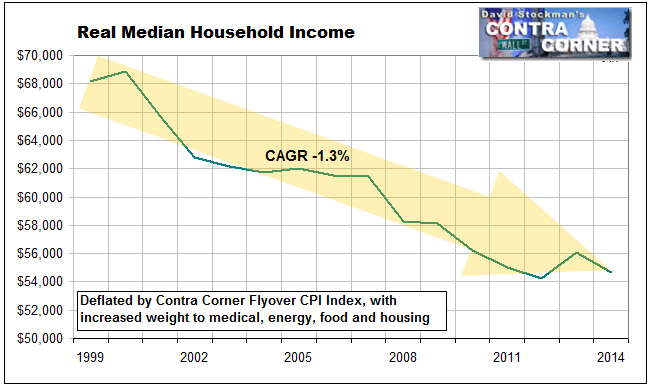
Even using the standard, understated CPI, real household income has been falling on an irregular basis since the turn of the century. That apparently does not phase the FOMC because their faulty model says they only thing that counts is spending—-even if from borrowed money and levered-up balance sheets.
Indeed, the Keynesian bathtub model is so primitive that households could be buried in twice today’s debilitating debt level—say $28 trillion versus the actual level of $14.2 trillion—and it would make no difference whatsoever. The more they borrowed, the higher would go the consumer spending and GDP computations.
In fact, however, real household income has plunged by 20% since the turn of the century when nominal incomes are deflated by our Flyover CPI. The chart-picture below actually explains better than the proverbial “thousand words” why the Fed is failing on the economic front and Donald Trump is succeeding in the political arena.
Real Median Household Income
We will have more to say in future installments about how the Fed’s destructive policies are squeezing the purchasing power of main street wages and salaries, but in light of today’s release of more bad data on manufacturing shipments, which was falsely spun as positive news by the MSM, it is worthwhile to look at one of the key precursors of wage and salary income.
Needless to say, the rate of capital investment profoundly impacts the competitive position of flyover zone workers versus the rest of the world. Yet today’s release on April orders and shipments for core manufacturers CapEx (less defense and aircraft) not only documented that this so-called recovery is rolling over; it actually nailed our indictment of Fed policy to the wall.
As shown in the chart below, orders and shipments are now down nearly 12% and 10%, respectively, from their September 2014 cycle high. You can’t call double-digit declines evidence of escape velocity.
But here is the more startling thing. Manufactures’ CapEx today is no higher than it was in the spring of 1999!
Yes, $4 trillion worth of Fed money printing ago (when its balance sheet was less than $500 billion) the monthly rate of capital spending in nominal terms was higher than it is today. And in inflation-adjusted dollars, it has descended into the sub-basement.
Where has all the investment gone?
Funnily enough, Goldman Sachs explained it about as well as anyone. The share of corporate cash flow being pumped back into the casino in the form of stock buybacks and dividends is now at an all-time high of nearly 50%—-or nearly double its turn of the century level.
And even that understates the case because the overwhelming share of M&A deals are driven purely by financial engineering based on cheap debt and purchase accounting games with post-acquisition earnings. The truth is, upwards of 60% of projected S&P 500 cash flow for 2016 will be cycled back into Wall Street according to Goldman projections.
That’s about $1.3 trillion, and the reason is hardly subject to dispute. Fed policy has turned the C-suites of corporate America into stock trading rooms. Investments in flyover zone businesses which might pay-off 5 years from now can hardly compete with stock option winnings next quarter.
Indeed, Fed policy has had a double whammy effect on the flyover zone economy. It drove inflation up when down was needed; and its strip-mined capital from American business when increased capital investment was of the essence.
Despite all the Fed’s palaver about “low-flation” and undershooting its phony 2% target, American workers have had to push their nominal wages higher and higher just to keep up with the cost of living.
But in a free trade economy the Fed’s wage-price inflation treadmill was catastrophic. It drove a wider and wider wedge between US wage rates and the marginal source of goods and services supply in the global economy.
Accordingly, at the end of the day it was the Fed which hollowed out the American economy. Without the massive and continuous inflation it injected into the US economy, nominal wages would have been far lower, and on the margin far more competitive with the off-shore.
That’s because there is a significant cost per labor hour premium for off-shoring. The 12,000 mile supply pipeline gives rise to heavy transportation charges, logistics control and complexity, increased inventory carry in the supply chain, quality control and reputation protection expenses, lower average productivity per worker, product delivery and interruption risk and much more.
In a sound money economy of falling nominal wages and even more rapidly falling consumer prices, American workers would have had a fighting chance to remain competitive, given this significant off-shoring premium. But the demand-side Keynesians running policy at the Fed didn’t even notice that their wage and price inflation policy functioned to override the off-shoring premium, and to thereby send American production and jobs fleeing abroad.
Needless to say, that giant blunder has gut-punched flyover America at its most vulnerable spot. That is, among workers with less than a college education.
And contrary to establishment propaganda, the devastating decline in the employment/population ratio shown below is not due to an aging demographic. The over 65 population’s workforce participation rate has actually soared.
The latter trend probably explains where Wal-Mart finds its greeters.
But both lines on the chart surely point to where the Donald is finding his voters.

(To be continued in Part 3)

Thursday, May 26, 2016

Afternoon naps

Some good information on the importance of afternoon naps (short naps).

Revealed: Why our brains get so tired in the afternoon - and how to beat the slump


Mark Molloy 
26 MAY 2016 • 11:47AM
It’s known as the dreaded 2:30 feeling.

You’ve had your eight hours of sleep, a very productive morning and a healthy lunch - but as the afternoon hits you start to fall into a post-lunch slump.

Feeling drowsy after lunch is completely natural, according to Dr Fiona Kerr, a neuro specialist from the University of Adelaide, who explains that humans are “built for two sleeps a day”.

“Sleep deprivation in general has a number of negative consequences to the creative process and to general and mental health,” she explains.

“The primary effect is the blocking of neurogenesis through increases in corticosterone levels but there is also a drop in attention capacity, executive function, working memory, quantification skills, logical reasoning, motor dexterity and mood.”

She adds the slump in the afternoon occurs because our bodies are effectively “programmed to nap” at that time.

“A major reason for this is that human beings are biphasic (physically designed for two sleeps a day), with two major bodily rhythms (homeostatic sleep drive and circadian arousal) which pull us in different directions in terms of staying awake or sleeping, but they fascinatingly align in the middle of the day to create a ‘nap zone’.

Dr Kerr suggests workers would benefit from a 15-minute midday nap, explaining it can offer a multitude of health benefits

They include increases in “cognitive function, memory, alertness, perception levels, stamina, mood, motor skills and creativity - along with decreased stress levels”.

“The most common nap is 15 to 20 minutes (often called the Stage 2 nap) which refreshes the brain and increases alertness and motor performance,” she adds.

“Having a nap of twenty minutes is also more beneficial than sleeping for an extra twenty minutes in the morning.

Research shows that a nap will temporarily improve mental operations, performance, reaction times and subjective feelings of alertness which can last up to 2 - 3 hours, according to Dr Kerr.


AT A GLANCE

Why lack of sleep is bad for your health

  • Regular poor sleep puts you at risk of serious medical conditions, including obesity, heart disease and diabetes – and it shortens your life expectancy.
  • Most of us need around eight hours of good-quality sleep a night to function properly – but some need more and some less.
  • As a general rule, if you wake up tired and spend the day longing for a chance to have a nap, it’s likely that you’re not getting enough sleep.
  • If you seem to catch every cold and flu that’s going around, your bedtime could be to blame. Prolonged lack of sleep can disrupt your immune system, so you’re less able to fend off bugs.
  • Lack of sleep can also make you put on weight
  • Chronic sleep debt may lead to long-term mood disorders like depression and anxiety.
  • Studies have suggested that people who usually sleep less than five hours a night have an increased risk of having or developing diabetes.
  • Long-standing sleep deprivation seems to be associated with increased heart rate, an increase in blood pressure and higher levels of certain chemicals linked with inflammation, which may put extra strain on your heart.
  • All info is from NHS Choices